A college internship can be the moment a career stops being a plan and starts being a passion.
I know this because it happened to me.
As an environmental biology student at Cal Poly Pomona, I completed an internship at the Puente Hills Habitat Preservation Authority as part of my curriculum. One spring morning, ecologist Shannon Lucas took me to the Colima Road wildlife underpass. We spread white gypsum powder on the ground and collected the SD card from a wildlife camera. The next day we returned to identify any animal tracks left behind. I studied the importance of wildlife corridors in class, but kneeling in the gypsum and tracing a coyote print that day made it real.
I spent weeks after that reviewing wildlife camera footage frame by frame. Watching those animals move quietly through the wildland-urban interface made something click. Land conservation isn’t just a concept studied in textbooks. It is the difference between a species surviving or disappearing. A few years later, with the internship listed on my resume, I was hired in an entry level position at Rivers & Lands Conservancy (RLC).
Studies show that students who apply coursework to hands-on service experiences gain not just technical skills but a stronger sense of civic responsibility and personal purpose that shapes their values after graduation. Service learning also helps nonprofits to extend their capacity through volunteer labor. It is for these reasons that RLC works with local universities today.
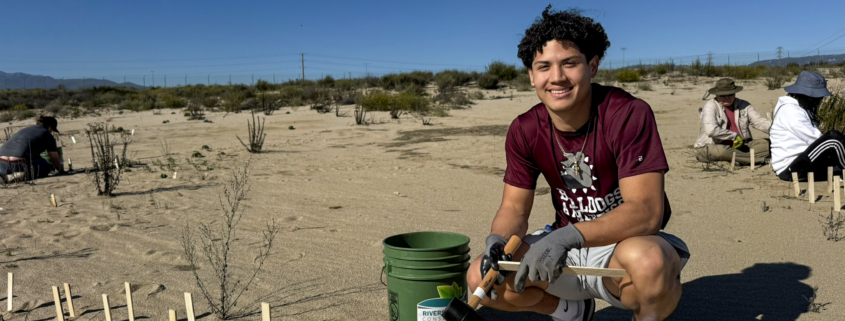
Earlier this year, Professor Alisa Slaughter brought her environmental nonfiction class from the University of Redlands to our Boruchin Preserve in Colton. Students helped restore habitat for the Delhi Sands flower-loving fly, an Inland Empire endemic and endangered species, by hammering cedar shims into eroding sand. The shims mimic vegetation and help stabilize the dunes. Students don’t just learn about conservation. They do conservation.
“It made me realize how little I know about my own environment,” said student Bijan Khodadadi. “This is only 30 minutes from where I grew up my whole life.”
Professor Slaughter says these experiences offer her students something rare: equal parts scientific rigor and human connection. These experiences also open doors. The connections made in the field with professionals and fellow volunteers often prove as valuable as the work itself.
Our partnership with Cal Poly Pomona goes further. Now in its second year, a micro-internship program places students from Professor Joan Leong’s Entomology Lab into fieldwork paid by the university on the conserved Colton Dunes. Up to 24 students work in small teams to collect, identify and pin insects at sites in Colton, Rialto and Fontana. Students gain real field biology skills, and the pinned collection will be used for years to inspire the public about native insect conservation and to train staff.
Biology major Jeremy Flores told Cal Poly Pomona’s newsroom. “It’s one thing to learn about identification characteristics in entomology class,” he said, “but applying them in the field really cements the concepts we learned.” For conservation-focused students, working alongside an organization like RLC means learning field skills like habitat restoration, land stewardship and insect collection that complement lab work. And when students work on projects with tangible results, they often become lifelong advocates. They carry that mission forward into their careers and communities.
The Colton Dunes cover less than 2 percent of their original 50-square-mile range. What remains exists because of sustained effort by many hands over many years, and because of students who came to learn and stayed to care.
I think about that coyote track in the gypsum powder and what it set in motion for me. These students are finding their own version of that moment. And the land is better for it.
Rivers & Lands Conservancy connects our community to natural, wild, and open spaces of Southern California through land conservation, stewardship, and education.
Nicole Padron is Co-Executive Director of Rivers & Lands Conservancy, overseeing its conservation programs. She holds a Master of Science (2013) and Bachelor of Science in Environmental Biology (2010) from Cal Poly Pomona.