
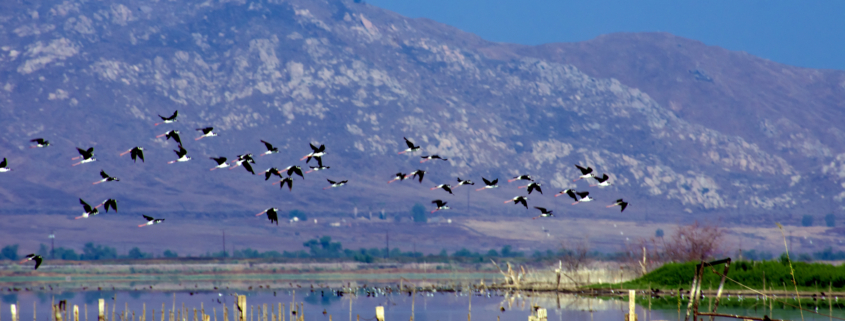
Dr. Anthony Metcalf has fond memories of visiting Mystic Lake with his father when he was a boy. He remembers strange smoking trash fires at the shoreline and the muddy mysteries of the wetlands. As a teenager, he returned to embrace the lake’s solitude and peace. It wasn’t until after receiving his Ph.D. and becoming a biology professor at California State University, San Bernardino that a love for ecology and birding brought him back. For the next 40 years, Mystic Lake’s incredibly diversity of wildlife, unique geohydrology, and status as a rare remaining Inland Southern California wetland kept him returning.
Located in the San Jacinto Valley and now a component of the San Jacinto Wildlife Area, the ephemeral Mystic Lake has captivated many. The lake itself is a wide spot in the San Jacinto River and while its plentiful water attracted settlers, seasonal flooding led to the construction of earthen levees over the past century to channelize the flow. In periods of drought, the lake disappears entirely. In heavy rain years, the decaying levees are overcome and the lake returns.
The seismically active San Jacinto and Casa Lorna faults run parallel through the San Jacinto Valley, creating a “pull-apart valley” between them. Mystic Lake sits in this natural tectonic “low spot” that would normally fill with sediment and water from the historic flows of the San Jacinto River, compensating for the subsiding lakebed. However, upstream diversion of the San Jacinto River from its historic flow and groundwater withdrawal has further contributed to the lakebed subsiding 1 to 2 inches a year. Over the last century, every time Mystic Lake has reformed, it has become deeper and larger.
Its formation makes Mystic Lake a fascinating subject to geologists. However, its importance to the Pacific Flyway, the migration route linking northern breeding grounds and southern wintering areas have made it famous. It’s this aspect that Metcalf hopes to see preserved.
“Imagine a least sandpiper,” Metcalf said. “It’s wintering down in the tropics and nests in the Arctic. This tiny bird must cross the continent and can only do this by having places to rest, feed and fatten up.”
The San Jacinto Wildlife Area, which includes Mystic Lake, is one of few remaining historic stopovers for migrating birds and for wintering birds that use riparian habitats in the region. Restoration of these habitats in the San Jacinto Wildlife Area has created havens for endangered birds like the least Bell’s vireo and tri-colored blackbirds. It has also created an incredible hotspot for birders, attracting over 300 species of birds a year and often hosting incidental and rare species.
This includes Metcalf’s specialty which is shorebirds. “Riverside County had the highest gull diversity in the state,” he said. “We’ve also had little stint, red-necked stint and wood sandpiper all in this relatively small location. Folks come from almost everywhere to look at the shorebirds in the fall.”
Visitors also come to see raptors such as golden eagles, bald eagles, and peregrine falcons and to get photographs. The San Jacinto Wildlife Area Birding group on Facebook has nearly 7,000 members who share their photos and tips for spotting birds. In December, the page was buzzing with the sighting of a zone-tailed hawk, a species that is rarely found in Southern California.
Preserving Mystic Lake and its attraction to a wide diversity of bird species will continue to require community support. According to Metcalf, the best outcome for the future of Mystic Lake is two-fold. The first would be to expand the area. The second would be to ensure water flows into Mystic Lake and if possible, mirror its historic flow.
“Mystic Lake is a big piece of Southern California’s natural history and the heart and soul of the wildlife area,” Metcalf said. “The lake is sort of the last stand. All the drainages coming out of the mountains in the form of pools and streams and wetlands now end in flood control basins. This is the last natural drainage left.”
Mystic Lake can be accessed by trails within the Davis Unit of the San Jacinto Wildlife Area which is located at 17050 Davis Road, Lakeview, California 92567.
Rivers & Lands Conservancy connects our community to natural, wild, and open spaces of Southern California through land conservation, stewardship, and education.
Rebecca K. O’Connor is the Co-Executive Director of Rivers & Lands Conservancy, has an MFA in Creative Writing and Writing for the Performing Arts from UC Riverside and is the author of several books on the natural world.