
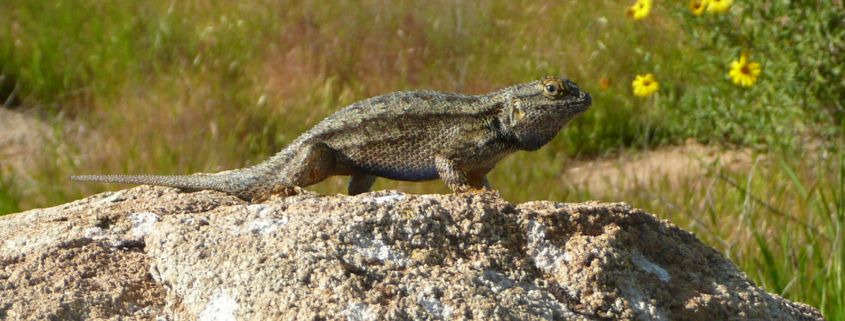
Some of Southern California’s most fascinating wildlife isn’t hiding deep in the remote wilderness, but found basking on concrete, rock, or a picket fence.
The western fence lizard (Sceloporus occidentalis) is one of the most common and resilient reptiles in Southern California. It is also one of the easiest to overlook. Whether you are hiking a local trail, walking through a neighborhood park, or spending time in your own backyard – chances are you have seen one doing what looks like tiny push-ups. For many people, that brief encounter ends there. For me, it sparked a lifelong fascination.
Growing up, I was intrigued by the western fence lizard. I remember finding them around my elementary school and catching them to bring home in a shoebox filled with grass. I thought I was creating the perfect home. My mom quickly reminded me they already had one. She taught me that wildlife is best appreciated where it belongs, and every lizard has a role to play in nature. Looking back, that simple lesson shaped the way I see the outdoors today.
My childhood curiosity eventually led me to study western fence lizards as a graduate student at California State University, San Bernardino. I spent countless hours observing them in the field and researching the effects of wildfires on predation risk, dorsal darkness, and background matching. This experience taught me that there is always more to discover about even the most familiar species.
One of the first things people notice is their behavior. If you watch closely, you may see a lizard repeatedly raising and lowering its body in a series of “push-ups.” Although it may look like they’re getting in a workout, these movements are a way to communicate. By raising and lowering their bodies, males display the bright blue patches on their throat and belly. These displays serve two important purposes: defending territory from rival males and signaling sexual fitness to potential mates.
Western fence lizards are more than entertaining to watch. They play an important role in keeping ecosystems healthy. They feed on ants, beetles, spiders, and other small insects, helping keep insect populations in balance. At the same time, they serve as an important food source for birds, snakes, and mammals. Even a small lizard contributes to the larger web of life that supports healthy habitats.
The protected lands and natural areas cared for by Rivers & Lands Conservancy provide habitat for countless native species, including the western fence lizard. Conserving these landscapes helps ensure that common wildlife remains a familiar part of our communities for generations to come.
The next time you visit a local park, preserve, or trail, slow your pace and take a closer look. You may spot a tiny lizard perched on a tree, soaking up the sun or doing its signature push-ups. What may seem like an ordinary encounter could become the beginning of a deeper appreciation for the remarkable wildlife living just outside your door.
Elmer Gutierrez is a Field Technician at Rivers & Lands Conservancy. He holds B.S. and M.S in Biology from California State University, San Bernardino.
Rivers & Lands Conservancy connects our community to natural, wild, and open spaces of Southern California through land conservation, stewardship, and education.