
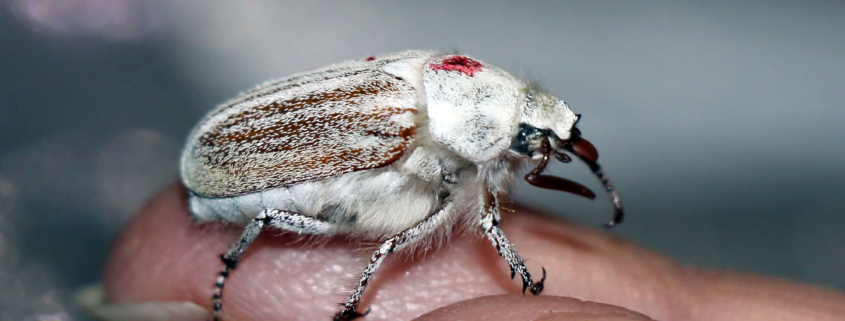
An indicator of ecological health of Southern California’s desert landscapes may lie in a beetle smaller than your pinky finger. The Casey’s June beetle not only plays a crucial role in their ecosystem but it also holds the potential to reveal deeper insights into local environmental change and conservation efforts. Why is this small insect so important, and what’s at stake in preserving it?
The Casey’s June beetle, Dinacoma caseyi, is a species of scarab beetle found only in Palm Canyon Wash and Tahquitz Creek in Palm Springs, California. With its distinctive dusty tannish-brown and cream-striped body, this beetle may appear unassuming at first glance. However, its role within the ecosystem is far more complex than folks realize. As a species adapted to the region’s Sonoran Desert wash and scrub habitat, it has evolved over millions of years but now faces growing threats from habitat loss, soil disturbance, flooding events, climate change and attraction to artificial light and water sources. Only about 350 acres within the species current range and distribution is permanently conserved.
Beetles, particularly scarab beetles, are essential for nutrient cycling in ecosystems. June beetles, known for their visibility flying in the twilights of late spring between March and June, feed on decaying organic matter as larvae, helping break down plant material and contributing to the decomposition process. This enriches the soil and helps plants grow, which supports other organisms up the food web. Without them, nutrient cycling would be inefficient, and ecosystems would lose their balance.
The beetle’s life cycle is closely tied to the health of Southern California native desert plants. As larvae, they also feed on plant roots, while adults consume leaves and flowers. It is not currently well understood which plant species and plant densities are needed to sustain Casey’s June beetle, however, it is commonly associated with perennials like cheesebush, creosote bush, saltbush, cholla cactus, catclaw acacia, and desert lavender.
One of the biggest threats to the species is habitat loss due to urban sprawl. As cities expand, they encroach on natural habitats, reducing the available space for the beetles to live, feed, and reproduce. Remaining habitat is further impacted by fragmentation, a process by which larger areas of habitat are broken up into smaller, isolated pieces, making it harder for beetles to reproduce and thrive. Fragmented habitats also suffer more from urban edge effects. Adjacent pools can act as pitfall traps, while light pollution can attract and disorient male June beetles during their short window to find their flightless mates.
Climate change also presents a growing problem. Rising temperatures and erratic rainfall patterns are altering the timing of plant blooming cycles, which affects the beetles’ feeding and breeding habits. Larvae development is sensitive to temperature fluctuations, and if conditions become too hot or dry, it may impact their survival. These ecological mismatches between the beetles’ life cycle and plant availability can lead to the active population declines we see today, which have contributed to the Casey’s June beetle being listed as federally endangered in 2011.
Protecting the Casey’s June beetle begins with habitat conservation and is improved with habitat restoration. In 2024, Rivers & Lands Conservancy began stewarding 14.4-acre conservation area that permanently protects critical habitat for the beetle in Palm Canyon Wash. The habitat is being restored by removing invasive plant species and allowing native plants to reestablish to support beetle food and shelter. The Christopher Gregory Casey’s June Beetle Conservation Area was named posthumously to honor U.S. Fish & Wildlife Service biologist, Christopher Gregory, for his dedication to Casey’s June beetle conservation and research.
By taking action now to protect the beetle and its habitat, we are helping to ensure the region remains populated with this incredibly special beetle, that deserves to remain a part of our world and help maintain the health and biodiversity of the desert.
Amy Tims is a land steward with Rivers & Lands Conservancy and has a B.S. in conservation biology with a focus on Native American & Indigenous Studies from UC Davis.
Rivers & Lands Conservancy connects our community to natural, wild, and open spaces of Southern California through land conservation, stewardship, and education.