Habitat restoration typically involves planting native plants, but a recent project in the Jurupa Hills required ripping them out.
Last month local community members came together to restore habitat for endangered species in the Jurupa Hills, in the cities of Fontana and Jurupa Valley, CA. The tasks involved collecting seeds from California buckwheat shrubs and subsequently removing them from the ground. Although curious onlookers might think the method was destructive, land managers assure the project will benefit endangered species.
The project was a collaboration between Rivers & Lands Conservancy (RLC), Western Riverside County Regional Conservation Authority (RCA), and Riverside County Regional Parks and Open Space District (RivCo Parks). All entities hold and manage conservation lands directly adjacent to each other, on either side of the shared Riverside and San Bernardino County line. The RLC holds the Jurupa Hills Conservation Easement in Fontana, and RCA manages the Teledyne Preserve in Jurupa Valley in conjunction with RivCo Parks. Both conservation areas, totaling approximately 41-acres, host the endangered Delhi sands flower-loving fly and the endangered California gnatcatcher.
These endangered species are limited by the habitats they require. The Delhi sands flower-loving fly is confined to a rare habitat type called the Colton sand dunes, consisting of fine grain sand and native shrub cover of 20-50%. The California gnatcatcher, a small, threatened bird, will only live in coastal sage scrub habitat characterized by a 50-70% cover of native shrubs like California buckwheat. Although their preferred habitats differ in vegetation density, the hope is to find a compromise. As a whole, RLC’s conservation area has a vegetation cover of 70% and limited Delhi sand deposits, providing much more territory for the gnatcatcher. A cover closer to 50% in the project area should enhance and expand occupied habitat for the sand fly while remaining suitable for the gnatcatcher. In contrast, the adjacent RCA managed lands have an abundance of suitable soils for the Delhi sands flower-loving fly, but buckwheat has spread well in recent years and threatens to choke out the best fly habitat available.
When it comes to actually removing the large buckwheat shrubs, it’s not a typical request for our staff. Amy Tims, RLC land steward shared “I’m not used to removing native vegetation like buckwheat. I’m usually ripping out invasives like mustard or tamarisk.” There was definitely a method to the madness and RCA’s Natural Resource Manager with RivCo Parks Jonathan Reinig, was the man with the plan. “We started by flagging shrubs for removal to reach our desired cover while still maintaining habitat value” Reinig shared, then added “It’s a lot of work, so we were glad to enlist help from volunteers.”
Many hands make light work, so we invited volunteers from the local community as well as the California Conservation Corps to join in on the fun. Overall, 13 staff members and 18 volunteers participated in the event.
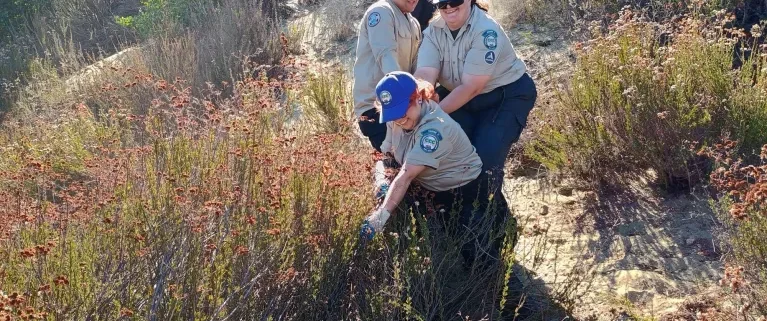
California Conservation Corps members led the charge in the buckwheat removal. The process involved wrapping a metal chain around the base of the plant and tugging it out with brute force. It took three to five corps members to win a game of tug-of-war with a buckwheat shrub depending on the root system. Once removed, the plants were carried to one of three trailers to be discarded as green waste. A total of 1.5 tons of vegetation was removed.
It wasn’t all waste though! Volunteers collected seed from the buckwheat skeletons with plans to be used in further restoration work. Rivers & Lands Conservancy has other conservation areas where the issue isn’t too much buckwheat, but not enough. Overall, volunteers helped collect three full trash cans, or about 100 gallons of seed.
The project area now looks more suitable for the sand fly. Vegetation cover is visually estimated to be around fifty percent.
RLC, the RCA, and RivCo Parks look forward to continuing their collaboration on this project and others. These groups aim to make collaborative opportunities such as this annual event, increasing habitat value within the preserves and continuing to provide opportunities for the public to participate in the conservation of our local natural resources. To learn more about volunteer opportunities with RLC, see the events page on our website www.riversandlastg.wpenginepowered.com.
Rivers & Lands Conservancy connects our community to natural, wild, and open spaces of Southern California through land conservation, stewardship, and education.