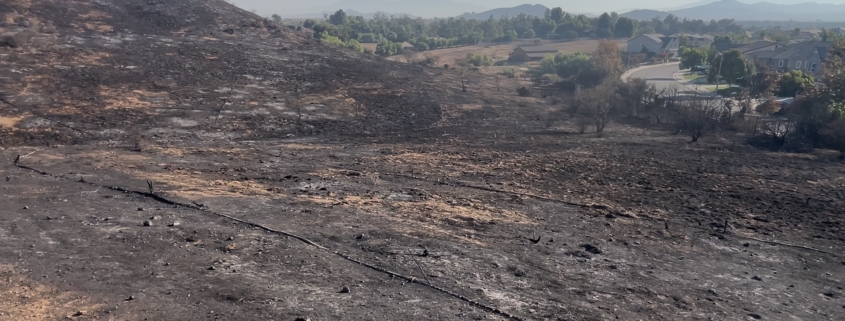
In August, the rapid-moving Keith Fire swept through a key conservation site managed by Rivers & Lands Conservancy in Murrieta, California.
As the warm morning sunrise began casting light upon the blackened slopes, the land was quiet except for the crunch of ash under my boots and gentle winds sweeping past. I paced the burn scar, scattering a few handfuls of native seeds and singing prayers back into the wind. The fire had taken almost everything from the landscape but gave back a thick layer of nutrient-rich char that seemed to blanket the land. Scattering some buckwheat and sage seeds, I visualized blooms pushing through the soot and regenerating the landscape with a vigor only made possible by fire. Fire-following wildflowers know how to come back, and I’m counting on them to lead the way.
In December 2023, Rivers & Lands Conservancy began stewarding a 4-acre portion of the “Country Roads” conservation easement held by the Western Riverside County Regional Conservation Authority in unincorporated Murrieta. On August 5, 2025, the Keith Fire swept through the site, destroying protected native Riversidean sage scrub and riparian habitat. The conservation area supports recovery efforts for wildlife species like the federally endangered Quino checkerspot butterfly (Euphydryas editha quino) and the threatened coastal California gnatcatcher (Polioptila californica californica).
The Quino checkerspot butterfly was once common across Southern California. Habitat loss and fragmentation have contributed to its decline, so recovery depends on protecting larval host plants and nectar sources like dotseed plantain, woolly plantain, white snapdragon and purple Chinese houses. Though the butterfly hasn’t been observed at Country Roads in decades, the land is being managed to restore crucial suitable habitat in hopes the butterfly will return. With the Keith Fire, a new layer of urgency has been added, spurring a race against time to outpace re-colonizing weeds blown in from surrounding areas.
“Many of our local plant communities are adapted to thrive in a landscape that occasionally burns. However, fires can still be detrimental to them,” said Jonathan Reinig, natural resources manager of the Western Riverside County Regional Conservation Authority. “Too rapid of a fire return interval, compounded by eager invasive plants nearby, can result in type conversion of habitats from native shrublands to nonnative grasslands.”
Before the fire, the area included chaparral plants like California buckwheat, sagebrush, deergrass and toyon. The riparian zone, which included mulefat and other native shrubs, was also scorched. Nonetheless, some cholla survived due to its water content and low flammability. Many fire-resilient California native plants have adaptations that help them regenerate from the base after fires. So, while the landscape has been flattened, many plants are still alive beneath the surface, ready to bounce back.
While we can expect the seedbank to germinate fire-following annuals promptly, in the many areas previously dominated by weeds it’s safe to expect more of the same without intervention. Perhaps most importantly, we will be removing invasive plants that germinate to give the native plants their best shot at regenerating and reclaiming the habitat.
While you can visit the general area via public hikes such as La Alba Trail and Rancho Los Alamos Loop in the Murrieta foothills, the Country Roads site itself is not open to the public. However, in the spring we will invite the public to participate with us in a fire-response restoration event focused on site recovery through invasive plant management within the burn scar. To get involved, keep an eye on our website for volunteer opportunities.
Post-fire restoration will take time, but as we begin to restore what was lost, we remain grounded in our mission to protect these open spaces for wildlife and future generations.
Amy Tims is a land steward with Rivers & Lands Conservancy and has a B.S. in conservation biology with a focus on Native American & Indigenous Studies from UC Davis.
Rivers & Lands Conservancy connects our community to natural, wild, and open spaces of Southern California through land conservation, stewardship, and education.

 Like Us on Facebook
  Find Us on Instagram
