
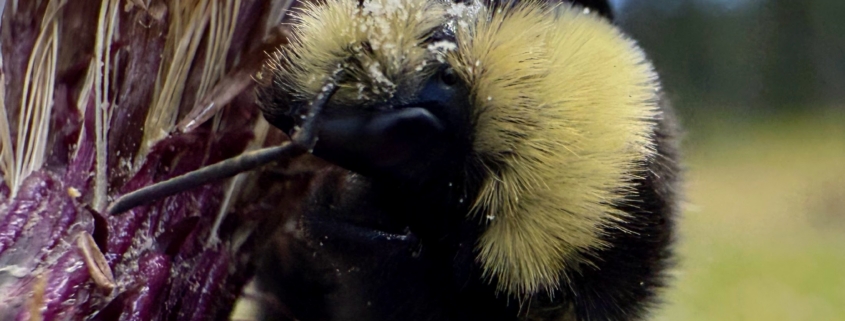
Stalking western meadowlarks with my camera, a smaller flash of flying black and yellow caught my interest. I don’t see bumblebees often and this one was not stopping at flowers, but it was on a mission. Intrigued, I followed the bee as it searched under mustard leaves, ignoring the California poppy blooms that had sprouted throughout the open space.
I showed Leif Richardson, Conservation Biologist with the Xerces Society for Invertebrate Conservation’s California Bumble Bee Atlas, video I shot with my phone. To my delight, he explained that I had the uncommon opportunity to watch a queen yellow-faced bumblebee (Bombus vosnesenskii) on her solo journey to start a colony of her own.
Historically, there were eight species of bumblebee that could be found in the Inland Empire but only six species can reliably be found in the region now, according to Richardson. While the yellow-faced bumble bee is one of the most common species, they are all facing the same challenges that are causing a widespread decline. Habitat loss, the shifting climate, pesticide exposure, disease, and competition from managed honeybees have all taken a toll. The queen I followed represented something increasingly precious.
Four native California bumble bee species, Crotch’s, Western, Franklin’s, and Suckley cuckoo, are considered imperiled. As of September 2022, all four are designated as candidate species under the California Endangered Species Act, granting them temporary legal protection. One of these, Franklin’s, is protected as Endangered by the federal Endangered Species Act, and two others, Western and Suckley, are being evaluated for the same protections.
The loss of bumble bees and other native pollinators is a critical issue for ecosystem health as well as crop production. California native plants such as manzanita, western redbud and sages depend on pollinators to help them reproduce. Many crop plants are pollinated by these wild insects too, meaning that insect imperilment could threaten the state’s large agricultural sector. Bumble bee pollinators may be critical to plants, but plant foods are also critical to the bees, fueling the development of complex social behavior and cooperative breeding.
Bumble bees are one of only a few social species of native bee in North America. In the spring, fertilized queens are on the hunt for suitable hollows for nesting. Most species nest underground, often in abandoned rodent holes. After locating a suitable nest site, the queen then crafts her first waxy brood cells, adds nutritious pollen and nectar, and lays her eggs. Once these first workers mature, she has all the help she needs to grow a colony throughout the summer. When the time comes, males and new queens emerge and the original colony’s life cycle ends. Only the new fertilized queens remain to hibernate through the winter.
Bumble bee colonies may be busy, social places, but the queens actually spend most of their lives solo, hibernating and later nest-founding without help. “If you think about it, they have this profound sociality that goes on for just a few months, but they start out alone.” Richardson said. “They must learn a lot on their own from the time they leave their colony as young queens. They are gaining experience they may be able to take into the following year if they survive overwintering and into the next spring. It is a perilous one-woman journey.”
It is difficult to think about the perils encountered by a bumblebee and not wonder how to help. Scientists lack the data needed to create conservation plans, but the community can help gather that data through the Bumble Bee Atlas at bumblebeeatlas.org. This community science project, active across 21 states including California, trains volunteers to survey, photograph, and report bumblebee sightings. In Southern California the season for Bumble Bee Atlas volunteers is just beginning.
Volunteers attend an online training workshop where they learn a non-lethal catch-and-release survey method in which they document bumble bee occurrences around the state. Volunteers need only an insect net, vials, a cooler with ice, a camera (cell phone cameras work) and access to the internet. Resources to learn more are available on the Bumble Bee Atlas site. You can also find information on other ways to help bumblebees on the Xerces Society’s site.
“We all need to work on the larger challenges together,” Richardson said. “Support pesticide reduction in agriculture, for example, by the purchasing choices you make at the grocery store. The easiest thing we can do is add flowering California native plants to our gardens. If enough people do that it can create significant change.”
I hope this change happens. I hope my bumble bee finds the perfect burrow and experiences the social side of the species. And may her daughters have the same luck, because the wilderness and all our gardens could benefit from more bumble bees.
Rivers & Lands Conservancy connects our community to natural, wild, and open spaces of Southern California through land conservation, stewardship, and education.
Xerces Society: https://xerces.org/
Bumblebee Atlas: https://www.bumblebeeatlas.org/
Rebecca K. O’Connor is the Co-Executive Director of Rivers & Lands Conservancy, has an MFA in Creative Writing and Writing for the Performing Arts from UC Riverside and is the author of several books on the natural world.